
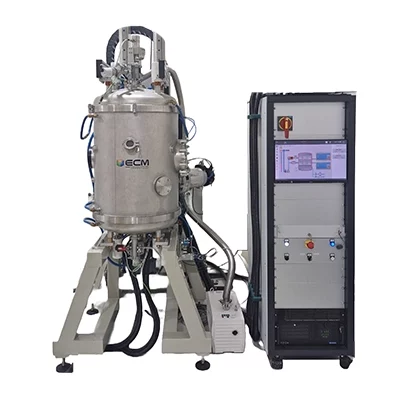
Technical specifications
Features
- ingot size up to 200 Kg
- Use of open crucible or a closed ampoule configuration
- Automatic control of the heating process
- Resistive or inductive heating system
Precise crucible translation
With a resolution up to 0.01 mm/h
Maximum pulling speed of the crucible
100 mm/min
Thermocouples system
For temperature measurement in the hot and cold zones
Maximum temperature
2600°C
Gradient
From 1° to 30°C / cm
Internal effective diameter
Up to 500 mm (or equivalent)
Robotic integration
Robotics integration : with ECM Robotics
Effective dimensions
Ø 100 mm single crystal setup
250 Kg mass Polycrystalline solidification setup
Options
- Possible vacuum chamber for primary and secondary vacuum
- Automatic control of solidification process via Cyberstar software
- Temperature measurement by Pyrometers
- Controlled mass flow of different atmosphere gases
Applications
This Bridgman furnace supports crystal growth applications across metallurgy, medical imaging, LED manufacturing, photovoltaics, telecommunications, and defense, wherever high-purity single crystals are required.
Industry
Used by research labs and manufacturers in metallurgy, medical imagery, LED, PV, telecommunications, and defense.
Material
The furnace is suited for growing SoG c-Si, III-V compounds, silicon, CaF2, cadmium telluride (CdTe), and InSb single crystals.
Bridgman Furnace FAQ
What's the difference between resistive and inductive heating on this furnace ?
Resistive heating suits most standard crystal growth processes, while inductive heating is recommended for higher-temperature or faster-response applications. ECM Lab Solutions configures the furnace based on your target material and process.
Bridgman vs Czochralski: which crystal growth method should I choose ?
The Bridgman method uses a stable temperature gradient and a moving crucible to solidify the melt directionally, making it well suited for large-diameter or high-mass ingots. Czochralski growth instead pulls a rotating seed crystal from a melt, offering finer control for smaller, ultra-high-purity single crystals such as those used in semiconductor wafers. The right choice depends on your target crystal size, material, and purity requirements — see our Czochralski furnace for comparison.
How does crucible rotation improve crystal quality ?
Rotating the crucible during growth homogenizes the thermal profile around the melt, reducing radial temperature gradients that can cause defects or non-uniform crystal structure. ECM’s Cyberstar rotating thermocouple system allows this rotation without losing accurate temperature readings in the hot and cold zones.
Is the Bridgman furnace compatible with robotic loading and unloading ?
Yes. We can integrate automation into your Bridgman furnace, useful for labs running repeated growth cycles who want to reduce manual handling between runs.